
Cloud instances
Swiss IaaS: Linux and Windows VMs, 3 DCs.
A Hikube instance is a virtual machine with guaranteed resources, hosted exclusively in Switzerland, controlled via API and console. Storage replicates across three datacenters, synchronously (real time) or asynchronously (improved performance).
- VMware import
- Windows Server
- 3-DC replication
- ISO 27001
- 3 DC
- SLA 99.99%
These instances are Swiss cloud compute for enterprise workloads: guaranteed CPU and RAM, 3-DC replication, Swiss law, no US parent. Teams leaving VMware or a hyperscaler get clear CPU/RAM flavors, image import, and a private network from the first project. No proprietary layer: your images, your tools, your CI.
Capabilities
VMware import
VMDK, QCOW2 and ISO. A VMware-exit path without rewriting applications.
Windows Server
Same flavors as Linux, including Windows Server 2025. Usage-based license, AD / files / .NET in the VPC. No Azure required.
3-DC replication
No extra “multi-AZ” SKU to stack. The volume chooses synchronous or asynchronous, always geo-redundant: see block storage.
API-first
Hikube API and console today. Terraform and Cluster API integration in preparation. Your images, your CI.
Swiss jurisdiction
Hidora SA, three Swiss sites. Not a US group’s “Switzerland” region.
14-day trial
No credit card. An engineer opens access. GPUs included.
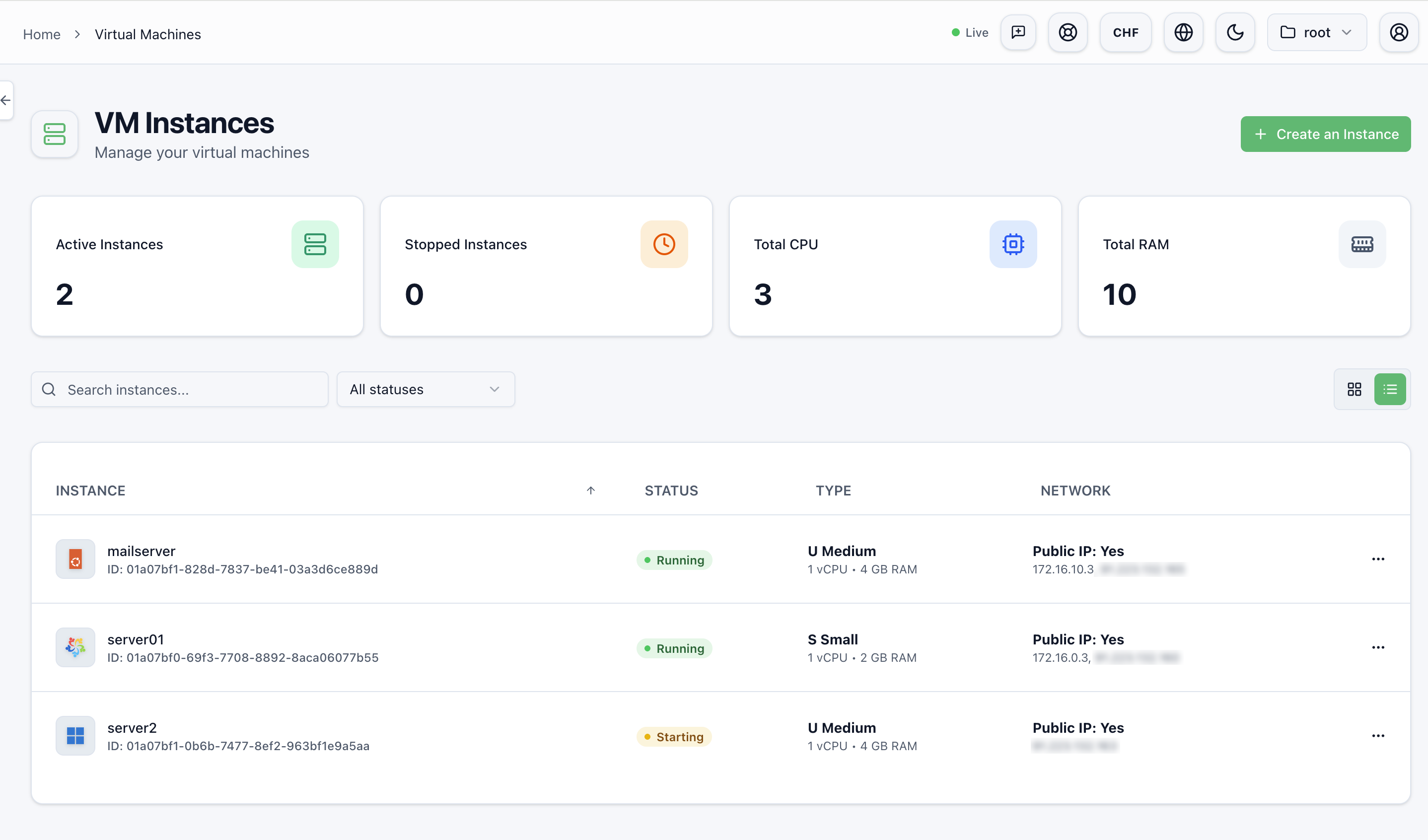
On the instance sheet
Windows, disks, SSH: what the engineer sees.
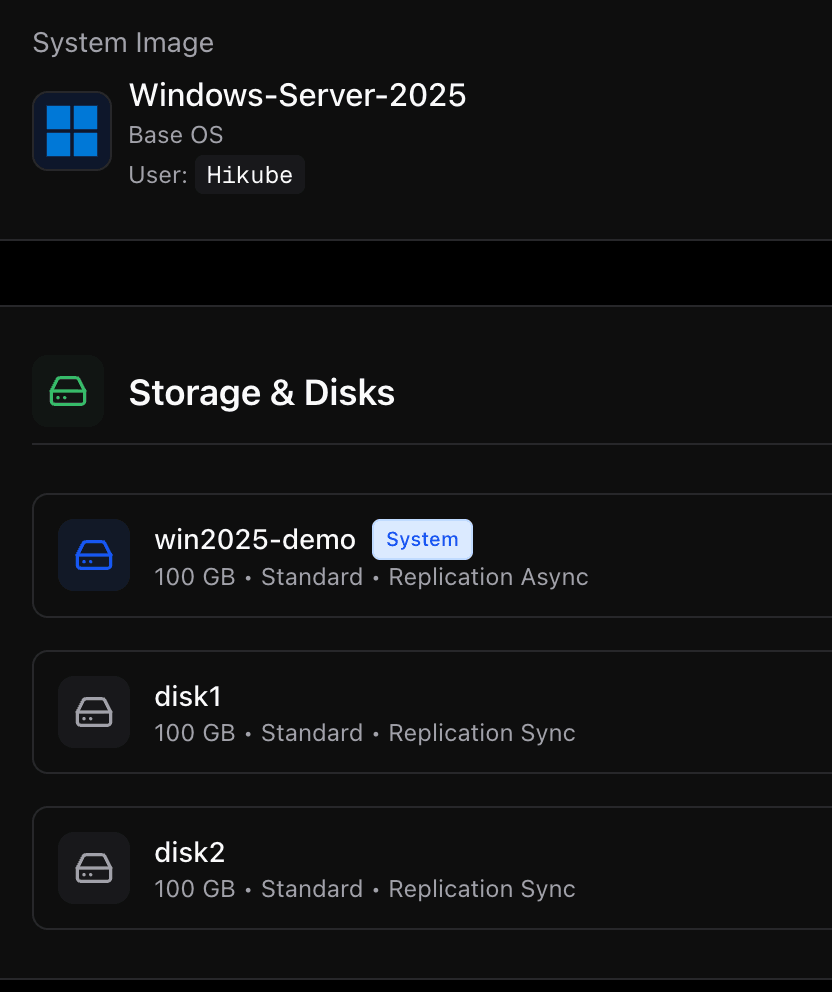
Windows Server 2025. System and data disks. Sync or async per volume.
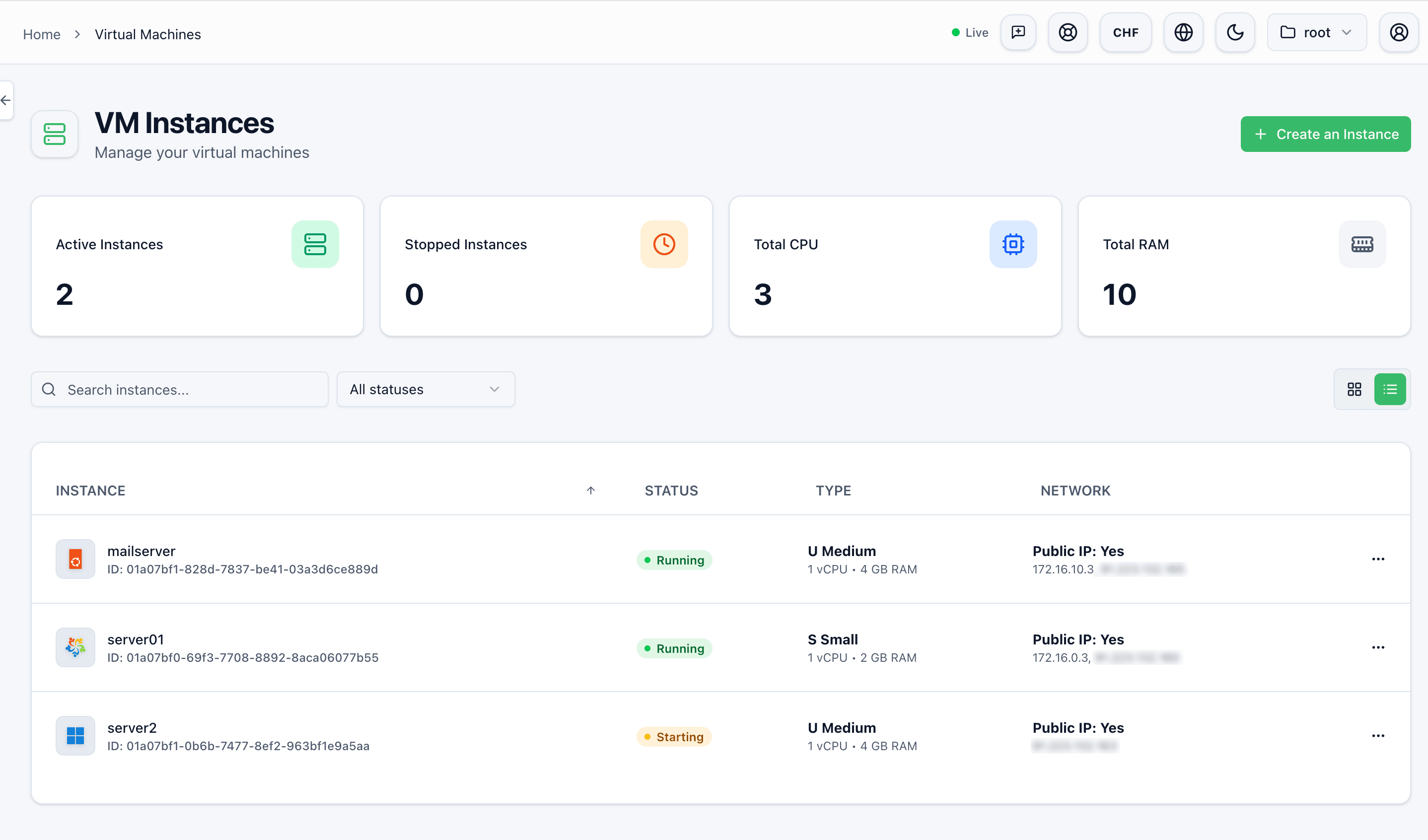
Public IP, SSH command, VPC, port 22.
In detail
The difference is not the vCPU: it is jurisdiction and risk. An EC2 in Zurich is still an Amazon service under the CLOUD Act. A Hikube instance is operated by a Swiss company, on three Swiss sites only, The catalog is narrower (not 200 PaaS products); the IaaS core (VM, disk, VPC, backup) is built to stay auditable.
Yes for lift-and-shift: the OS travels with the disk. Active Directory, files and .NET stay licensed Windows VMs. Kubernetes modernization is a second wave, workload by workload. A 10–20 VM pilot frames the network (VLAN → subnets) before the factory run.
No. It is a catalog image (including Windows Server 2025) and a license on the same cloud instances. AD, file shares, IIS and .NET stay VMs, in the same VPC as Linux. System and data disks are managed separately; replication mode (sync or async) shows per volume. The license bills on usage with the instance, without the Azure stack or an opaque SPLA. This is not a substitute for Microsoft 365 or Entra at group scale.
No. Azure is coherent if group strategy is Microsoft cloud end-to-end. If the constraint is “no CLOUD Act” or a VMware exit, licensed Windows VMs in Switzerland cover AD, files and .NET. Entra / 365 can stay at Microsoft; line-of-business compute moves.
Website, ERP, Active Directory, files, .NET or Linux: teams often start with VMs. Billed in CHF, VPC and backup from the first project. Kubernetes, GPUs, S3 and databases stay available on the same tenant.
An instance is not only a size: four things are billed or decided alongside it, and forgetting them makes an estimate wrong by half. The order below is the configurator’s.
- The size: vCPU and memory, in a catalogue family. It is the only line most people estimate, and rarely the one that surprises
- The disk: billed per gigabyte per month, separately from the instance, and replicated across the three sites, block storage
- The public address, if the machine must be reachable from the internet. Otherwise it stays in the VPC, which is the right default: the VPC private network
- The OS: Linux at no extra cost, Windows Server licensed on usage and billed per vCPU. Count the Windows vCPUs before, not after
- What stays yours, whatever the size: the operating system and its patches, the applications, the accounts, application monitoring. The platform operates the hypervisor and the hardware, not your OS
Hikube operates the hypervisor, the 3 DCs, the underlay network, block replication and engineer support. You keep the OS, packages, app, users and application backups. Windows licenses at 10 CHF/vCPU on the same instance.
Not necessarily. Many SMEs start with Linux or Windows VMs, a VPC and backup, billed in CHF. Kubernetes and GPUs stay available if needed, on the same tenant. An engineer frames the first project; the 14-day trial opens the tenant with no credit card.
The flavor publishes vCPU and RAM. Engineer support is included. Block storage, public IPv4, the Windows license (10 CHF/vCPU/month) and GPUs bill separately, at published prices. u1, m1 and s1 families: pricing page.
Frequently asked questions
Yes. Hikube is Swiss cloud IaaS (VMs, managed Kubernetes, GPU, S3, backup, vault) operated by Hidora SA on three datacenters: Geneva, Gland, Lucerne. Published SLA 99.99%, ISO 27001, engineer support in French and English. It is not shared web hosting. GPUs are in the 14-day trial. Windows Server is a licensed image on instances.
No. Hikube is a sovereign cloud: compute, storage, backups and metadata stay on three independent Swiss datacenters (Geneva, Gland, Lucerne). There is no replication to the EU or the United States.
The operator is Hidora SA, a Swiss company in Lancy (Geneva), with no US parent. Compute, storage, backups and metadata stay in Geneva, Gland and Lucerne. That is not the same legal basis as AWS, Azure or GCP. We are not your counsel: GDPR for EU data in Switzerland relies in particular on adequacy.
Through the Hikube API and the console. Terraform and Cluster API integration in preparation. kubectl, Helm and S3 clients stay. Docs: docs.hikube.cloud.
Ubuntu, Debian, CentOS, Windows Server (including 2025), plus ISO / custom image import. Windows is not a separate product: same instance, usage-based license.
The trial opens the tenant. The Windows Server license is published at 10 CHF/vCPU/month, on the same instances.
A Linux or Windows VM, a VPC and a backup. From 24 CHF/month (s1.small). No card. Kubernetes and GPUs stay optional.
Ready to run on 100% Swiss infrastructure?
14-day trial, no credit card. GPUs included.