
Compare
A Swiss alternative to OpenShift: upstream Kubernetes, operated for you
An OpenShift alternative for platform teams in Switzerland: CNCF-certified Kubernetes on Talos, operated by Hidora SA in three Swiss datacenters.
- Standard Kubernetes, CNCF certified (Certified Kubernetes Hosted)
- Operated in Switzerland by a Swiss company, Hidora SA
- CHF or EUR pricing, no per-core subscription: control plane 32 CHF/month, workers on usage
- ISO 27001
- 3 DC
- SLA 99.99%
OpenShift or managed Kubernetes: what is the difference?
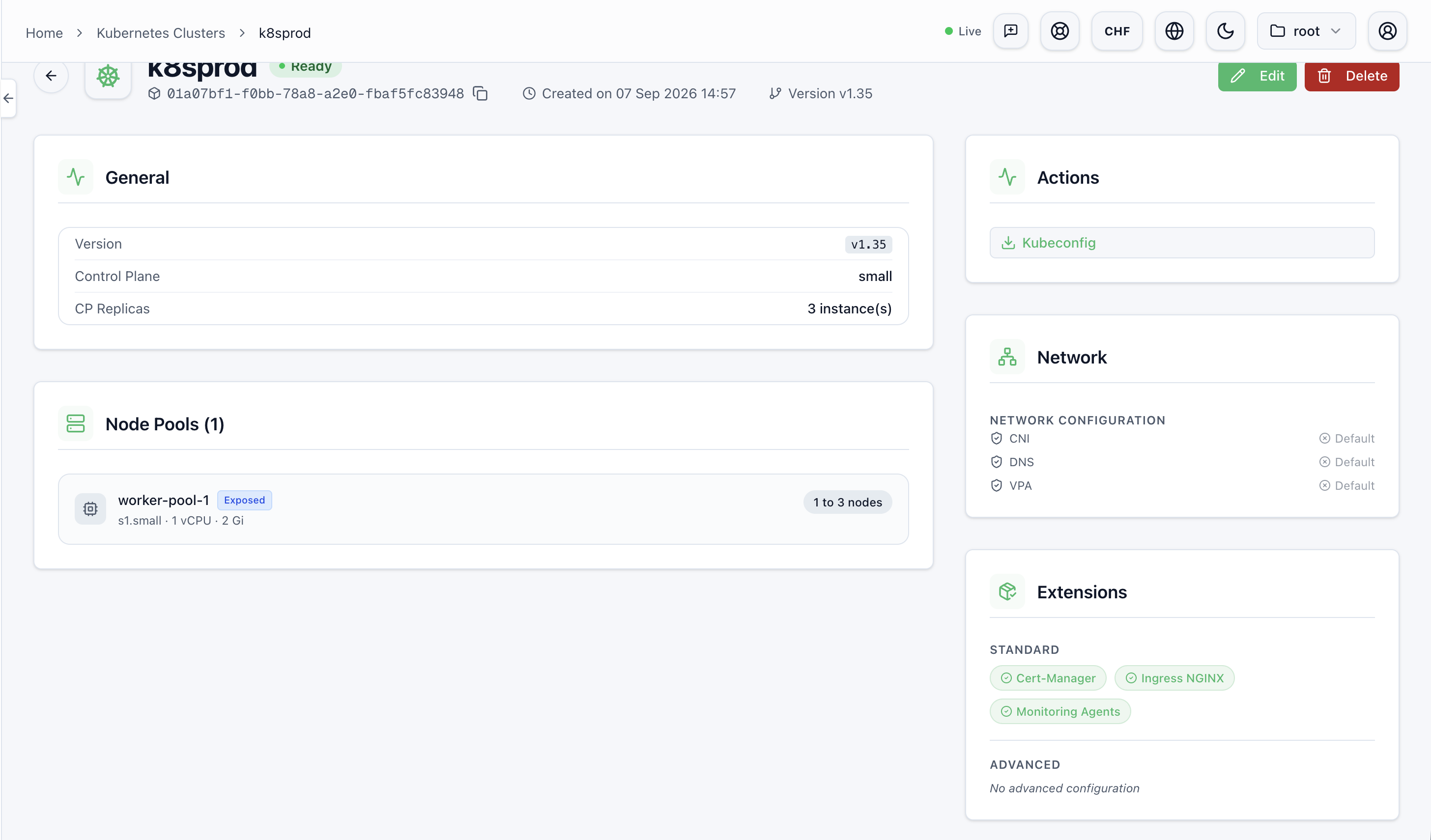
OpenShift is a Kubernetes distribution that Red Hat extends and sells by subscription. On top of Kubernetes it adds a developer console, Routes to expose services, Security Context Constraints, BuildConfig and Source-to-Image builds, ImageStreams and OperatorHub. It is itself a CNCF-certified distribution, and for a team that uses all of these layers the integration has real value. Hikube makes the other choice: certified upstream Kubernetes, a dedicated control plane operated by Hidora SA, and the standard CNCF ecosystem for the rest. Ingress or Gateway API to expose services, Pod Security Admission with Kyverno or OPA Gatekeeper for policies, your own CI for builds, Helm for operators. kubectl, Helm, Flux and Argo CD do not change. OpenShift-specific objects do, and they are converted before the migration. The service itself is described on managed Kubernetes.
Comparison table: OpenShift and Hikube Managed Kubernetes
| Capabilities | Hikube | Red Hat OpenShift |
|---|---|---|
| Kubernetes | Upstream, Certified Kubernetes Hosted (CNCF) | Red Hat distribution, CNCF certified |
| Node OS | Talos Linux, immutable, no SSH | RHCOS (Red Hat Enterprise Linux CoreOS) |
| CNI | Cilium | OVN-Kubernetes by default |
| Control plane | Dedicated per cluster, its own API server and etcd, operated by Hidora | Self-managed, or a managed service depending on the offering |
| Pricing model | Control plane 32 CHF/month, workers on usage | Subscription |
| Location | 3 DCs in Switzerland only: Geneva, Gland, Lucerne | Depends on the chosen hosting |
| Operator | Hidora SA, a Swiss company | Red Hat, an IBM company (United States) |
| GitOps | Your tools: Flux, Argo CD, Helm, kubectl | OpenShift GitOps (based on Argo CD) |
| Certifications | ISO 27001 (SQS), KCSP | Depends on the host |
How to read this table. It compares a Kubernetes distribution sold by subscription with a managed Kubernetes service, not two equivalent products. The OpenShift column only states what Red Hat’s public documentation describes, and carries no price: OpenShift is sold as several offerings (self-managed, or managed on a cloud provider) whose terms differ. Where a row depends on the offering or the host, it says so rather than guess. Hikube prices are on the pricing page; to compare against your own figures, use the TCO calculator.
What carries over, what changes
| On OpenShift | On Hikube |
|---|---|
| Routes | Ingress (Hikube add-on) or Gateway API |
| Security Context Constraints (SCC) | Pod Security Admission, plus Kyverno or OPA Gatekeeper policies |
| DeploymentConfig | Deployment |
| BuildConfig / S2I | CI pipelines (Tekton, GitHub Actions, GitLab CI) pushing to Hikube Registry as a Service |
| ImageStreams | Image tags in the registry |
| OperatorHub | Operators installed with Helm or OLM, or Hikube add-ons: ingress, cert-manager, monitoring, GPU operator |
| OpenShift console | Hikube console, plus your tools: Lens, Headlamp, k9s |
Teams that depend heavily on the OpenShift developer console or on S2I will have to adapt their pipelines. We discuss it before the migration, not after. For the build and deploy side, see CI/CD pipelines on Kubernetes.
Migrating from OpenShift to Hikube
01
Inventory
Namespaces, workloads, and the OpenShift-specific objects and CRDs: Routes, SCC, BuildConfig, ImageStreams, DeploymentConfig, operators.
02
Conversion
Routes to Ingress, SCC to Pod Security Admission and policies, BuildConfig to CI pipelines, DeploymentConfig to Deployment. Helm charts and standard manifests carry over as they are.
03
Parallel run
A trial cluster next to OpenShift, fed by the same GitOps repository, tested under real load.
04
Cutover
DNS and traffic switched to Hikube, OpenShift kept as a fallback until validation ends.
Why a Swiss alternative to OpenShift
The question is not only technical. Hikube is operated by Hidora SA, a Swiss company with no US parent, under Swiss law: the CLOUD Act does not apply to it as it does to a US operator. Clusters run in three Swiss datacenters, Geneva, Gland and Lucerne, and PVCs replicate between them, synchronously or asynchronously. The published SLA is 99.99%, and engineer support answers in French and English from Geneva. To build an internal platform on top: the Kubernetes platform. Evidence and certificates: the security and compliance evidence.
Frequently asked questions
Standard Kubernetes objects, yes: Deployments, Services, ConfigMaps, Secrets, StatefulSets and Helm charts apply as they are. OpenShift-specific objects, no: Routes, DeploymentConfigs, BuildConfigs, ImageStreams and SCCs are converted to their standard equivalents. The inventory at the start of the migration lists them, namespace by namespace.
Yes. Argo CD or Flux manage workloads inside the cluster, as on any Kubernetes; the Hikube API creates the cluster, node groups, registry and VPC. Your GitHub Actions or GitLab CI pipelines push their images to Hikube Registry as a Service. Only pipelines built on BuildConfig or S2I need rewriting.
On Hikube, the dedicated control plane costs 32 CHF/month per cluster, and workers are billed on usage, in CHF or EUR, like cloud instances. We do not publish an OpenShift price: it depends on your offering and your contract. To compare against your own figures, use the TCO calculator; Hikube prices are on the pricing page.
Yes. GPU node groups carry the NVIDIA cards, with the GPU operator add-on. The catalogue: the GPU catalog.
Yes. The control plane, etcd, PVCs, registry images and backups stay in Geneva, Gland and Lucerne. Nothing replicates to the EU or the United States.
Ready to run on 100% Swiss infrastructure?
14-day trial, no credit card.